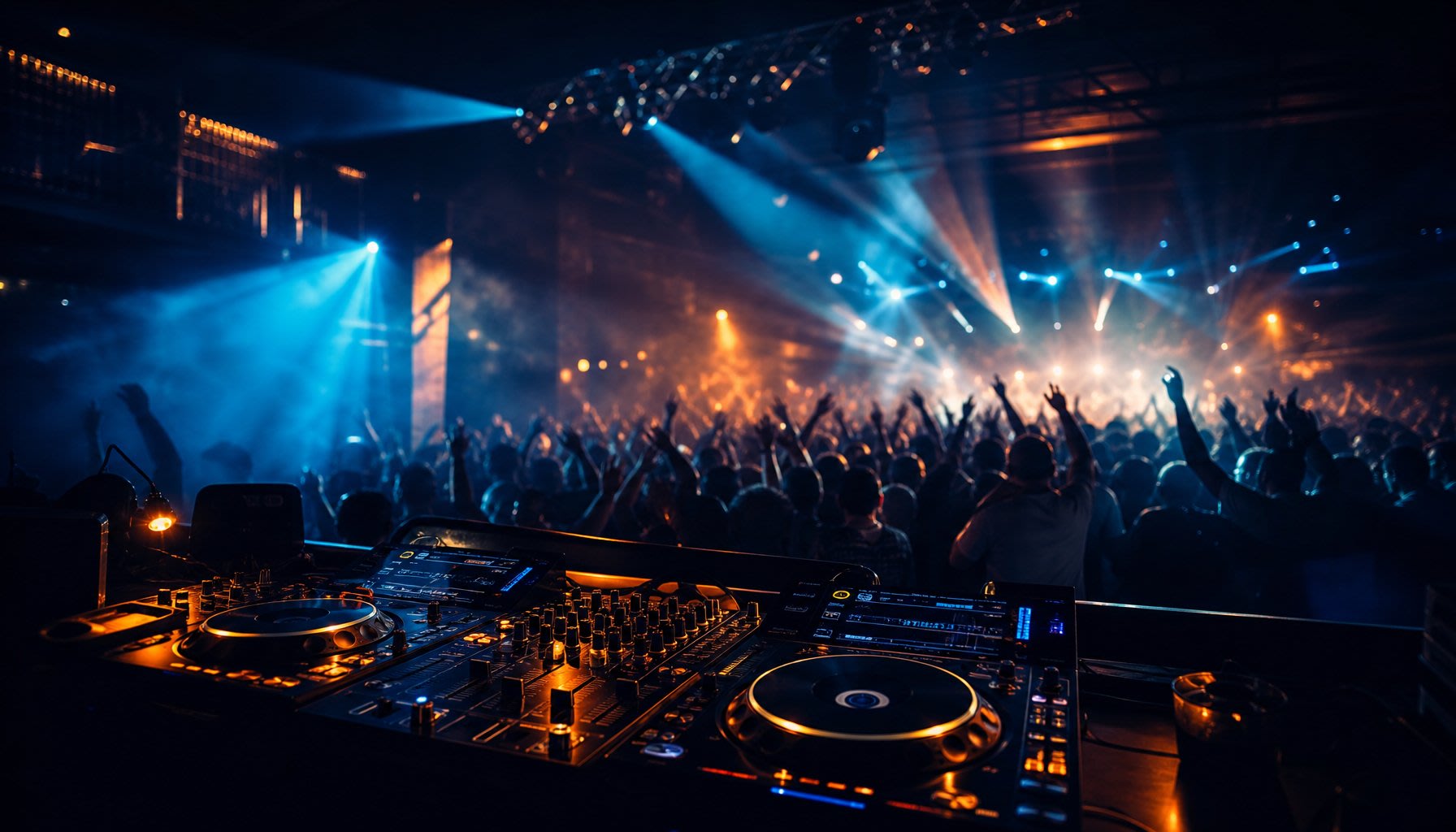
There's a moment at every great night event — the lights dim just right, a bassline rolls in like a slow tide, and the crowd collectively exhales into the music. That moment doesn't happen by accident. It's the result of deliberate craft: a carefully curated soundscape, a synchronized lighting plan, and a DJ who knows how to read the room. Welcome to the world of the OLED Soundscape — where every frequency and every photon is intentional.
🎼 Section 1: The Art of Song Selection for Cinematic Nights
Building the emotional architecture of your set
A cinematic playlist isn't just a collection of good songs — it's a narrative arc. Think of it like a film score: it has a beginning that draws people in, a middle that builds tension and release, and an end that leaves a lasting impression. The OLED Soundscape philosophy treats every track as a scene in a larger story.
🌑 The Three-Act Structure of a Night Set
🌘 Act I — The Arrival (First 45–60 min)
Set the mood without overwhelming. Think deep house, lo-fi soul, ambient electronica. BPM range: 90–110. Tracks like Bonobo's "Kong", Nils Frahm's "Says", or Bicep's "Glue" work beautifully here.
🌗 Act II — The Build (Core Hours)
Introduce energy progressively. Layer in melodic techno, cinematic bass, and emotional peaks. BPM range: 118–128. Artists like Moderat, Jon Hopkins, and Peggy Gou shine here.
🌕 Act III — The Climax & Resolution (Final Hour)
Peak energy, then a graceful wind-down. The crowd should feel euphoric, not abruptly cut off. BPM range: 128–135, then descend back to 100–110 for the close.
🎯 Key Song Selection Principles
- 🔑 Emotional resonance over popularity — A lesser-known track that hits the right emotional note beats a chart-topper that breaks the mood.
- 🔑 Key compatibility — Use harmonic mixing (Camelot Wheel) to ensure tracks flow without clashing tonally.
- 🔑 Dynamic range — Alternate between dense, layered tracks and sparse, breathing ones to prevent ear fatigue.
- 🔑 Cultural sensitivity — Know your audience's musical DNA. A corporate gala crowd differs vastly from a rooftop art event crowd.
- 🔑 The "anchor track" strategy — Plant 2–3 universally beloved tracks at strategic moments to re-engage drifting attention.
💡 Pro Tip: Build a "mood board playlist" of 80–100 tracks before the event. You'll only play 40–50, but having options means you can pivot instantly when the crowd shifts.
🔀 Section 2: Seamless Transitions — The Invisible Art
When the mix is so smooth, the crowd never notices the seams
The best transitions are the ones nobody notices. A jarring cut or a clumsy beatmatch can shatter the cinematic spell you've spent an hour building. In the OLED Soundscape framework, transitions are treated as micro-compositions — brief moments of artistry that connect two worlds.
🎛️ Transition Techniques for Cinematic Sets
🌊 The Long Blend
Overlap two tracks for 32–64 bars. Works best with ambient or deep house tracks. Creates a seamless "dissolve" effect like a film fade.
⚡ The Filter Sweep
Use a high-pass or low-pass filter to gradually strip frequencies from the outgoing track while the incoming one blooms in. Cinematic and dramatic.
🎭 The Tension Drop
Strip the mix to just a single element (a pad, a vocal, a kick) before introducing the new track. Creates anticipation and release — pure cinema.
🔇 The Silence Cut
A brief, deliberate moment of near-silence (1–2 seconds) before a powerful drop. Used sparingly, it's one of the most impactful tools in a DJ's arsenal.
📐 Technical Transition Checklist
- ✅ BPM alignment — Match or pitch-shift within ±3 BPM for natural-feeling blends
- ✅ Key matching — Use Camelot Wheel or Mixed In Key software before the event
- ✅ EQ management — Never have two full bass frequencies playing simultaneously
- ✅ Gain staging — Keep output levels consistent; avoid sudden volume jumps
- ✅ Cue point preparation — Mark intro, outro, and breakdown points in your DJ software before the event
👁️ Section 3: Reading the Crowd — The Human Algorithm
No playlist survives first contact with the crowd — adapt or lose them
Even the most meticulously planned set is just a starting hypothesis. The crowd is the experiment. Great DJs are part musician, part psychologist — constantly scanning the room, interpreting body language, and adjusting in real time. This is the skill that separates a good DJ from a legendary one.
📊 The Crowd Signal Matrix
🟢 POSITIVE SIGNALS
- Bodies moving toward the floor
- Hands in the air during drops
- Groups forming and dancing together
- Singing along to lyrics
- Eye contact and smiles directed at the booth
🔴 WARNING SIGNALS
- People drifting to the bar or edges
- Phones out, heads down
- Conversations louder than the music
- Crossed arms or static body language
- Requests for dramatically different genres
🧠 Adaptive Strategies
- 🎯 The "anchor and pivot" move — Play a universally recognized track to re-engage the crowd, then pivot to your intended direction from that energy high.
- 🎯 Energy laddering — If the crowd is flat, don't jump to peak energy immediately. Climb the ladder: +5 BPM, +5 BPM, +5 BPM. Gradual escalation feels natural.
- 🎯 The "reset" — If a track isn't landing, don't panic. Blend out gracefully within 2 minutes. The crowd rarely notices a smooth exit.
- 🎯 Talk to the room — Brief, confident mic moments ("How's everyone feeling tonight?") can reset the energy and buy you time to recalibrate.
💡 Pro Tip: Arrive at the venue 30–45 minutes before your set. Watch how the crowd moves, what they're drinking, how they're dressed. This pre-set observation is worth more than any amount of playlist preparation.
💡 Section 4: The OLED Lighting Plan — Painting with Light
Sound and light are one instrument — play them together
The term "OLED Soundscape" is inspired by OLED display technology — where true blacks make colors appear more vivid, and every pixel is independently lit. Apply this philosophy to your lighting design: use darkness as a canvas, and let light emerge with intention, precision, and drama.
🎨 Lighting Zones & Color Philosophy
Deep Blues & Indigos — The Arrival Phase
Cool, low-saturation blues create an intimate, mysterious atmosphere. Use wash lights at 20–30% intensity. Evokes the feeling of a late-night city skyline.
Amber & Deep Orange — The Build Phase
Warm, cinematic tones that evoke fire and passion. Introduce moving heads with slow pan movements. Pairs perfectly with melodic techno and emotional house.
Deep Purples & Magentas — The Peak Phase
High-energy, euphoric colors. Combine with strobes (used sparingly) and beam lights for maximum impact at peak moments. The crowd should feel like they're inside the music.
True Black — The OLED Principle
Don't be afraid of darkness. A 3–5 second blackout before a major drop is one of the most powerful tools in live performance. Silence + darkness = maximum anticipation.
🔧 Essential Lighting Equipment for Night Events
- 🔦 LED Par Cans — Versatile wash lights for ambient color flooding
- 🔦 Moving Head Beams — Dynamic, programmable spotlights for dramatic sweeps
- 🔦 Laser Systems — Geometric patterns that respond to music (use with caution in crowded spaces)
- 🔦 Haze/Fog Machines — Make beams visible and add depth to the atmosphere
- 🔦 Strobe Lights — Use sparingly for peak moments; always check venue policy and epilepsy warnings
- 🔦 LED Strips & Uplighting — Architectural accents that transform the venue's physical space
🏟️ Section 5: Venue Coordination — The Partnership That Makes It All Work
The best DJs are also the best collaborators
A stunning soundscape can be completely undermined by poor acoustics, a venue manager who cuts the music at the wrong moment, or a lighting technician who doesn't know your cues. Venue coordination is not optional — it's the foundation that everything else is built on.
📋 Pre-Event Venue Checklist
🔊 Sound System Audit
- Speaker placement and coverage zones
- Subwoofer positioning for bass response
- Monitor/foldback availability
- Cable routing and DI box availability
- Noise limiter settings and curfew times
💡 Lighting Rig Assessment
- Existing house lighting capabilities
- DMX control availability
- Power supply for additional rigs
- Rigging points for overhead fixtures
- Emergency lighting requirements
🤝 Staff Coordination
- Identify the venue's point of contact
- Agree on communication signals/cues
- Confirm set times and hard stops
- Discuss crowd capacity and flow
- Emergency protocols and contacts
🗣️ Communication Scripts That Work
Use these conversation starters when coordinating with venue managers:
EXAMPLE COORDINATION DIALOGUE
"I'd like to walk the space 2 hours before doors open — can we schedule a 20-minute tech check with your AV team?"
"What's the noise limiter set to, and is there any flexibility for the peak hour between 11pm–1am?"
"I'll need a signal from your team 15 minutes before last call so I can begin the wind-down sequence gracefully."
💡 Pro Tip: Always get the venue's technical rider in writing before the event. Verbal agreements about sound levels, curfews, and equipment availability are the most common source of night-of conflicts.
🌟 Putting It All Together: The OLED Soundscape Manifesto
The philosophy behind the craft
The OLED Soundscape isn't a formula — it's a philosophy of intentionality. Every element of a great night event — the song selection, the transitions, the lighting, the crowd interaction, the venue setup — is a thread in a larger tapestry. Pull any one thread carelessly, and the whole picture unravels.
But when it all comes together — when the bass hits at the exact moment the lights shift from deep blue to burning amber, when the crowd moves as one organism, when a stranger turns to another stranger and they share a moment of pure, wordless connection — that's the magic you're crafting. That's the OLED Soundscape.
Ready to Create Your Own Soundscape?
Whether it's an intimate rooftop gathering or a large-scale night event, we bring the full OLED Soundscape experience to every performance.
🎧 Book Your EventWritten by the DJ Craft Team
Specialists in cinematic event experiences, sound design, and live performance craft. Available for bookings of all sizes.